A Route 66 road trip itinerary is best planned over about 14 days, giving you time to travel from Chicago through Illinois, Missouri, Kansas, Oklahoma, Texas, New Mexico, Arizona, and California without turning the trip into a cross-country sprint. This guide builds the journey around manageable driving days, worthwhile historic stops, and practical overnight bases, with shorter 7-day and 10-day options for travelers with less time.
Table of Contents
Historic Route 66 is no longer a single continuously designated U.S. highway. The original route was gradually replaced by the Interstate Highway System and officially decommissioned in 1985, while many surviving sections are now marked or preserved as Historic Route 66. That means planning the trip requires more than entering “Route 66” into your navigation app.
This guide is designed to make that planning easier. Below, you’ll find a practical Chicago-to-California itinerary, recommended overnight stops, shorter-route alternatives, seasonal considerations, budgeting guidance, and historic Route 66 attractions worth adding along the way.
How this guide was researched: This itinerary was developed using information from the Federal Highway Administration, National Park Service resources, official Route 66 and state tourism resources, attraction information, and current route-planning data. Driving distances should be treated as estimates because Historic Route 66 follows different alignments in some areas and modern navigation may route drivers onto nearby interstates.
How Long Does a Route 66 Road Trip Take?
Plan about 14 days for a full Route 66 road trip from Chicago to California if you want a practical balance between driving and sightseeing. A 10-day trip is possible with longer driving days, while seven days requires a much faster pace and leaves considerably less time for historic towns, museums, roadside attractions, and spontaneous stops.
The historic route stretches roughly 2,400 miles across eight states, although the exact mileage of a modern trip varies. Route 66 changed alignments during its history, and today’s drivers often combine surviving historic sections with local roads and Interstate highways.
For most travelers, the number of days matters more than the historic route’s exact mileage. A two-week schedule gives you enough flexibility to spend time outside the car instead of treating Chicago-to-California as a race.
Route 66 Trip Length Comparison
| Trip Length | Recommended Approach | Driving Pace | Best For |
|---|---|---|---|
| 4 days | Drive one section of Route 66 | Fast | Travelers interested in a regional Route 66 experience |
| 7 days | Full route is possible but rushed; a partial route is more practical | Very fast | Travelers with limited vacation time |
| 10 days | Chicago to California with carefully selected stops | Moderate to fast | Travelers who want the major highlights |
| 14 days | Full Chicago-to-California itinerary | Comfortable | Most first-time Route 66 travelers |
| 21 days | Full route with additional towns and detours | Relaxed | Travelers who want a slower road trip |
Route 66 at a Glance
| Route 66 Fact | Details |
| Historic length | Approximately 2,400 miles |
| Traditional starting point | Chicago, Illinois |
| Western end | Southern California |
| States crossed | Illinois, Missouri, Kansas, Oklahoma, Texas, New Mexico, Arizona, California |
| Established | 1926 |
| Removed from the U.S. Highway System | 1985 |
| Recommended trip length | About 14 days for most first-time travelers |
| Typical direction | Chicago to California, although the route can be driven in either direction |
The National Park Service describes Historic Route 66 as an approximately 2,400-mile route connecting Chicago with Southern California across eight states. The highway was created in 1926 and remained part of the U.S. Highway System until its decommissioning in 1985. Because different historic alignments survive today, your actual road-trip mileage will depend on which sections you choose to follow.
When Is the Best Time for a Route 66 Road Trip?
For most travelers, late spring and early fall are the easiest seasons for a Route 66 road trip because they can reduce exposure to the most extreme summer desert heat while still providing reasonable conditions across much of the route. May, September, and early October are particularly practical months to consider, although weather can vary considerably between Chicago, the Great Plains, high-elevation areas of Arizona and New Mexico, and the Mojave Desert.
Route 66 crosses several very different climate zones, so there is no single month that guarantees ideal weather across the entire journey. Conditions that feel comfortable in Illinois or Missouri can be dramatically different by the time you reach Arizona and California.
Route 66 Weather by Season
| Season | What to Expect | Planning Consideration |
|---|---|---|
| Spring (March–May) | Temperatures generally become more comfortable as the season progresses, but weather can be changeable across the Plains and Southwest. | Check forecasts regularly and allow flexibility for storms or changing road conditions. |
| Summer (June–August) | Long daylight hours are useful for sightseeing, but desert sections can experience dangerous heat. | Carry plenty of water, avoid unnecessary activity during extreme heat, and check heat advisories before desert driving. |
| Fall (September–October) | Often a practical balance between comfortable driving conditions and fewer extreme-heat days. | Later in the season, monitor colder conditions at higher elevations. |
| Winter (November–February) | A Route 66 trip is still possible, but conditions vary greatly across the route and snow or ice can affect higher-elevation sections. | Build additional flexibility into the itinerary and check road and weather conditions before each driving day. |
Be Especially Careful With Desert Heat
The western Route 66 corridor passes through desert areas of Arizona and California, including the region around Kingman, Needles, and Barstow. Extreme summer heat here should be treated as a trip-planning issue rather than simply an inconvenience.
Before driving these sections during hot weather, check the National Weather Service forecast and active heat alerts. Carry more drinking water than you expect to need, keep your vehicle fueled, and avoid relying on a single remote fuel or food stop being open.
Weather conditions can change throughout a two-week road trip, so check forecasts for your next destination each morning rather than relying on the forecast you saw before leaving home.
How to Choose Your Route 66 Road Trip Itinerary Length
The right Route 66 itinerary depends on whether your priority is completing the full Chicago-to-California journey or spending more time exploring each stop. For a first trip, 10 to 14 days provides a much better balance than trying to cover the entire route in less than a week.
4 Days: Choose One Section
Four days is too short for a worthwhile drive across the entire historic route. Instead, focus on one region. A Southwest section through New Mexico, Arizona, and California gives you access to historic Route 66 towns, desert scenery, roadside landmarks, and the western end of the journey without spending nearly every waking hour in the car.
7 Days: Fast-Paced
You can cover Chicago to California in seven days, but the schedule requires long driving days and selective sightseeing. For travelers who want time to explore, a partial Route 66 trip is the better seven-day option.
10 Days: Full Route With Major Highlights
Ten days gives you enough time to complete the full journey while stopping at major Route 66 attractions. You’ll still need to prioritize your stops, but the pace is considerably more manageable than a seven-day crossing.
14 Days: Best for Most First-Time Travelers
For most first-time travelers, 14 days is the best balance of driving and sightseeing. A two-week schedule creates room for historic towns, roadside attractions, museums, meals, and shorter driving days without requiring a three-week vacation.
14-Day Route 66 Road Trip Itinerary: Chicago to California
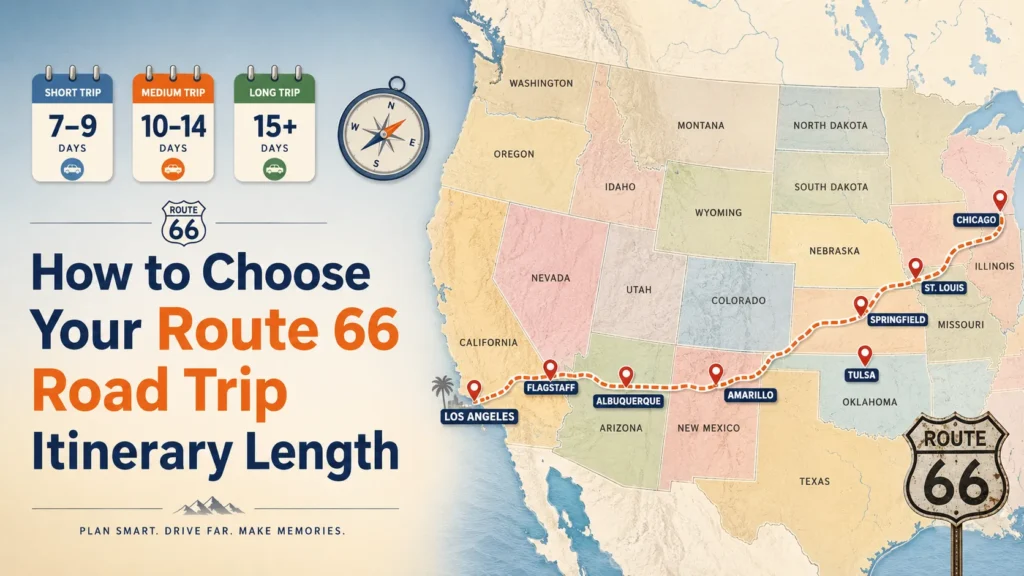
This 14-day Route 66 itinerary follows the classic east-to-west journey from Chicago to Southern California, using practical overnight stops to break the roughly 2,400-mile trip into manageable sections. Driving distances are approximate because Historic Route 66 has multiple alignments and modern navigation may occasionally route you onto nearby Interstate highways.
| Day | Route | Approx. Distance | Overnight |
|---|---|---|---|
| 1 | Chicago → Springfield, Illinois | 200 miles | Springfield, IL |
| 2 | Springfield → St. Louis, Missouri | 100 miles | St. Louis |
| 3 | St. Louis → Springfield, Missouri | 215 miles | Springfield, MO |
| 4 | Springfield → Tulsa, Oklahoma | 180 miles | Tulsa |
| 5 | Tulsa → Oklahoma City | 120 miles | Oklahoma City |
| 6 | Oklahoma City → Amarillo, Texas | 260 miles | Amarillo |
| 7 | Amarillo → Tucumcari, New Mexico | 115 miles | Tucumcari |
| 8 | Tucumcari → Albuquerque | 175 miles | Albuquerque |
| 9 | Albuquerque → Gallup | 140 miles | Gallup |
| 10 | Gallup → Flagstaff, Arizona | 185 miles | Flagstaff |
| 11 | Flagstaff → Kingman | 150 miles | Kingman |
| 12 | Kingman → Needles, California | 65 miles | Needles |
| 13 | Needles → Barstow | 145 miles | Barstow |
| 14 | Barstow → Santa Monica | 130 miles | Santa Monica |
Distances are rounded planning estimates rather than exact Historic Route 66 mileage.
Days 1–3: Illinois and Missouri
Start in Chicago and follow the historic corridor southwest through Illinois. The first few days introduce the classic Route 66 mix of small towns, roadside attractions, historic businesses, and larger cities.
Springfield, Illinois makes a practical first overnight stop before continuing toward St. Louis. From there, continue southwest through Missouri toward Springfield, Missouri. Keeping these first stages relatively manageable gives you time to stop rather than simply watching Route 66 disappear through the windshield.
Days 4–6: Kansas, Oklahoma and Texas
Continue toward Tulsa, passing through the short but historic Kansas section of Route 66 before entering Oklahoma. Tulsa and Oklahoma City make convenient overnight bases and give you more time to explore Oklahoma’s substantial stretch of the historic highway.
From Oklahoma City, continue west toward Amarillo, Texas. Build time into this day for roadside stops rather than treating Amarillo purely as somewhere to sleep.
Days 7–9: New Mexico
After Amarillo, continue west toward Tucumcari, one of the route’s best-known historic overnight towns. The next stages take you through Albuquerque and toward Gallup.
New Mexico deserves several days because Route 66 follows different historic alignments in the state. Travelers interested in spending additional time in Santa Fe can modify this portion of the itinerary rather than trying to squeeze the detour into an already busy driving day.
Days 10–11: Arizona
Continue from Gallup toward Flagstaff, with opportunities to explore Route 66 history and the landscapes of northern Arizona along the way. The following day takes you west toward Kingman.
If you want to add the Grand Canyon, consider adding an extra day instead of treating it as a quick roadside stop. It is a substantial destination in its own right and works better as an extension to this itinerary.
Days 12–14: California and the Route 66 Finish
From Kingman, head toward Needles and begin the California portion of the trip. The western stretch crosses desert country before reaching Barstow and eventually the Los Angeles area.
Allow extra time for desert driving, particularly during hot weather, and check current road and weather conditions before setting out.
On Day 14, continue from Barstow toward Santa Monica, completing the east-to-west journey at the Pacific. Rather than packing the final day with additional long-distance detours, leave enough time to enjoy the end of the trip and the transition from the open road into greater Los Angeles.
Route 66 by State: What You’ll See Along the Way
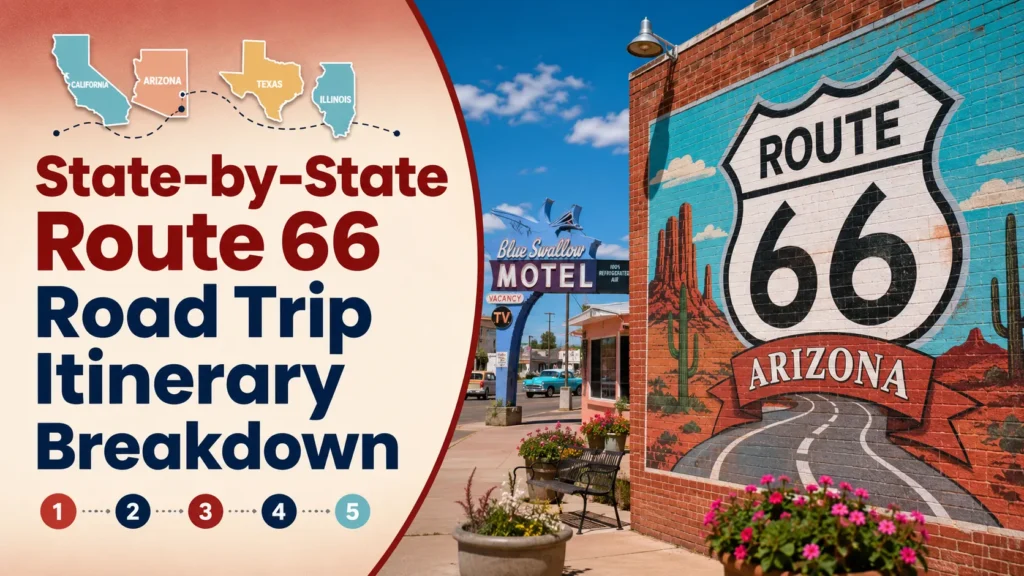
Route 66 crosses eight states, and each part of the journey feels different. Rather than relying on one exact mileage figure for every state, remember that Historic Route 66 changed alignments during its lifetime. Your actual distance will depend on which historic sections and modern connecting roads you choose to drive.
| State | Key Route 66 Stops | What to Expect |
|---|---|---|
| Illinois | Chicago, Joliet, Wilmington, Springfield | The traditional beginning of the journey, with historic towns and classic roadside attractions as you travel southwest from Chicago. |
| Missouri | St. Louis, Cuba, Lebanon, Springfield | A mix of urban Route 66 history, rolling countryside, historic businesses, and roadside stops. |
| Kansas | Galena, Riverton, Baxter Springs | The shortest Route 66 section of any state, but an easy addition when traveling between Missouri and Oklahoma. |
| Oklahoma | Tulsa, Oklahoma City, Arcadia | One of the most substantial parts of the journey, with historic road segments, small towns, roadside architecture, and major cities. |
| Texas | Shamrock, Amarillo, Adrian | A relatively compact Panhandle crossing known for restored roadside architecture, Cadillac Ranch, and the Route 66 midpoint area. |
| New Mexico | Tucumcari, Santa Rosa, Albuquerque, Gallup | Historic motels, neon, desert landscapes, and multiple Route 66 alignments that reflect how the highway changed over time. |
| Arizona | Holbrook, Winslow, Flagstaff, Seligman, Kingman | Some of the trip’s best-known historic towns, long surviving road sections, and access to major Southwest landscapes. |
| California | Needles, Amboy, Barstow, Los Angeles, Santa Monica | Desert driving gives way to the Los Angeles area and the traditional Pacific-end experience in Santa Monica. |
If Route 66 is part of a longer Texas road trip, see our Big Bend National Park attractions guide for another Southwest itinerary idea. Big Bend is not a Route 66 stop, so plan it as a separate extension rather than a quick detour from Amarillo.
Don’t Skip Route 66 in Kansas
Kansas has only about 13–14 miles of Route 66, but the short section passes through Galena, Riverton, and Baxter Springs. Because it sits directly between Missouri and Oklahoma, it can be included without adding another full travel day to the itinerary.
Understanding the New Mexico Route
New Mexico requires a little more planning because Route 66 did not always follow the same path. The earlier alignment traveled north through Santa Fe before returning south toward Albuquerque, while a major 1937 realignment created a more direct east-west route through Albuquerque.
If Santa Fe is important to your trip, treat it as an intentional historic-route detour or add extra time rather than assuming it sits directly on the later Route 66 alignment..
Route 66 Landmarks Worth Adding to Your Itinerary
The best Route 66 stops aren’t limited to one state, so leave some flexibility in your daily schedule for historic districts, roadside architecture, preserved highway sections, and classic attractions. These are several stops worth considering as you travel west.
Blue Whale of Catoosa, Oklahoma
The Blue Whale of Catoosa is one of the classic roadside attractions associated with Route 66 in Oklahoma. It works well as a relatively short stop when traveling through the Tulsa area rather than requiring a major itinerary change.
Cadillac Ranch, Texas
Just west of Amarillo, Cadillac Ranch makes an easy stop during the Texas portion of the trip. The public art installation features a row of Cadillacs buried nose-first in the ground and can be worked into the journey before continuing west toward New Mexico.
Blue Swallow Motel, New Mexico
The Blue Swallow Motel in Tucumcari opened in 1942 and is listed on the National Register of Historic Places. Its historic architecture, garages, and restored neon make it more than simply somewhere to sleep; it is part of the Route 66 history you’re traveling to see.
Petrified Forest National Park, Arizona
Petrified Forest National Park is particularly relevant to Route 66 travelers because it is the only national park in the National Park System containing a section of Historic Route 66. A Route 66 pullout inside the park marks the former highway alignment with the old roadbed, historic telephone poles, and a vintage Studebaker.
Give this stop more time than a typical roadside attraction if you also want to explore the Painted Desert, viewpoints, trails, and other areas of the national park.
Seligman and Kingman, Arizona
Seligman preserves an important part of Route 66’s roadside history, including surviving historic alignments and a commercial district shaped by generations of highway travelers.
Farther west, Kingman’s Commercial Historic District contains buildings associated with the city’s development before and during the Route 66 era. Together, Seligman and Kingman make the Arizona portion of the journey worth exploring rather than simply using Interstate 40 to cross the state as quickly as possible.
Mojave Desert, California
The stretch toward Needles, Amboy, and Barstow introduces one of the journey’s most isolated landscapes. Services can be limited on parts of the Mojave Route 66 corridor, so check current road conditions, fuel availability, weather, and operating hours before choosing your exact historic-road alignment.
This is one section where preparation matters just as much as sightseeing.
What to Eat Along Route 66
Food stops are an easy way to experience the different regions along Route 66 without adding major detours to your itinerary. Depending on your route, you’ll find everything from classic diners and roadside cafés to regional specialties such as Illinois horseshoe sandwiches, Oklahoma onion burgers, Texas barbecue, and New Mexico green chile dishes.
Rather than planning every meal before leaving home, choose a few historic or locally known stops that fit naturally into your overnight cities. Chicago, St. Louis, Tulsa, Oklahoma City, Amarillo, Albuquerque, Flagstaff, and the Los Angeles area all provide considerably more dining choice than the smaller Route 66 towns between them.
For remote stretches, particularly in the Southwest, don’t assume every historic café or roadside business will be open when you arrive. Check current operating hours before setting out and keep water and basic snacks in the vehicle as a backup.
Where to Stay: Booking Hotels and Tours Along Route 66
For the 14-day itinerary above, choose accommodations based primarily on location and daily driving distance. Staying near your planned route makes it easier to start early the following morning without adding unnecessary backtracking.
The main overnight bases in this itinerary are:
| Day | Overnight Stop | Why It Works |
|---|---|---|
| 1 | Springfield, Illinois | Breaks up the first day from Chicago and keeps you on the historic corridor. |
| 2 | St. Louis, Missouri | Provides time to explore the city instead of immediately continuing west. |
| 3 | Springfield, Missouri | A practical stop before continuing through Kansas toward Oklahoma. |
| 4 | Tulsa, Oklahoma | Good base for exploring Route 66 history in northeastern Oklahoma. |
| 5 | Oklahoma City | Keeps the Oklahoma portion manageable before the longer drive toward Texas. |
| 6 | Amarillo, Texas | Convenient base for Cadillac Ranch and the Texas Panhandle section. |
| 7 | Tucumcari, New Mexico | Known for surviving Route 66 motels and neon along the historic corridor. |
| 8 | Albuquerque | Offers a broad range of accommodations and easy access to Route 66 history. |
| 9 | Gallup, New Mexico | Convenient overnight stop before continuing into Arizona. |
| 10 | Flagstaff, Arizona | Useful base for northern Arizona and optional additional sightseeing. |
| 11 | Kingman, Arizona | Well positioned for the western Arizona Route 66 section. |
| 12 | Needles, California | Breaks up the desert portion of the California journey. |
| 13 | Barstow, California | Practical final overnight stop before reaching the Los Angeles area. |
| 14 | Santa Monica / Los Angeles | Marks the end of the westbound Route 66 journey. |
Historic Motels or Regular Hotels?
Historic Route 66 motels can add character to the trip, but you don’t need to stay in one every night. Consider choosing one or two historic properties and using regular hotels for the remaining overnight stops based on your budget, parking needs, and preferred amenities.
One notable example is the Blue Swallow Motel in Tucumcari, which opened in 1942 and is listed on the National Register of Historic Places. Arizona’s Wigwam Motel in Holbrook is another preserved Route 66-era property listed on the National Register.
If a particular historic motel is important to your trip, check availability directly with the property before finalizing the rest of that day’s route. Also verify current check-in policies, parking arrangements, and cancellation terms before booking.
If you’re comparing online hotel-booking options for the trip, our Booking.com review explains the platform’s booking process, cancellation considerations, and potential issues to check before reserving accommodation.
How Much Does a Route 66 Road Trip Cost?
The cost of a Route 66 road trip depends heavily on fuel prices, vehicle efficiency, accommodation style, meals, attractions, and optional detours. For a 14-day trip, it is better to build your budget from your own travel dates than rely on one fixed total.
| Expense | How to Estimate It |
|---|---|
| Fuel | Estimated trip miles ÷ your vehicle’s MPG × current average fuel price |
| Hotels | Nightly room rate × number of nights |
| Food | Your preferred daily food allowance × travelers × 14 days |
| Attractions | Add admission costs only for attractions you actually plan to visit |
| Parking & local costs | Allow extra for city parking and other local travel expenses |
| Emergency buffer | Keep additional money available for unexpected changes or vehicle-related expenses |
Example Fuel Calculation
For planning purposes, suppose your complete trip covers about 2,500 miles after local driving and your vehicle averages 25 MPG:
2,500 miles ÷ 25 MPG = 100 gallons
If gasoline costs $3.50 per gallon during your trip:
100 gallons × $3.50 = approximately $350 in fuel
This is only an example—not a prediction of what your trip will cost. Check current fuel prices shortly before departure and recalculate using your own vehicle’s fuel economy.
Accommodation will usually be one of the largest expenses on a two-week trip. Compare rates for your actual travel dates in each overnight city, especially if you want to stay at smaller historic Route 66 properties with limited rooms.
Leave some flexibility in the budget for unplanned stops. One of the advantages of a road trip is being able to spend extra time somewhere you didn’t expect to enjoy.
DIY Route 66 Trip or Road Trip Package?
A DIY Route 66 road trip is the better fit if you want control over your overnight stops, driving pace, historic-road sections, and optional detours. It also makes it easier to change plans when you discover a town or attraction where you want to spend more time.
A Route 66 road trip package may suit travelers who prefer having major parts of the trip arranged in advance. Before booking one, check exactly what the price includes, such as accommodations, transportation, attraction admission, guided activities, or rental-car costs.
For the 14-day itinerary in this guide, a DIY approach works particularly well because you can reserve your key overnight stays separately while keeping the rest of the journey flexible.
Route 66 Driving, Navigation & Packing Tips
Driving Historic Route 66 requires a little more preparation than following a modern Interstate from beginning to end. The historic highway has multiple alignments, and some sections now use local roads while modern navigation apps may direct you toward nearby Interstate highways.
Navigation
Plan each day’s route before leaving your hotel and download offline maps for areas where mobile service may be unreliable. A Route 66-specific map or guide can also help identify historic alignments that standard navigation may bypass.
Don’t assume every road marked as part of an old Route 66 alignment is currently open or suitable for your vehicle. Check current road conditions when planning less-traveled sections, particularly in desert areas.
Fuel and Desert Driving
Keep an eye on your fuel level when crossing remote parts of New Mexico, Arizona, and California. Before entering a long desert section, identify your next reliable fuel stop rather than waiting until the tank is nearly empty.
During hot weather, carry extra drinking water in the vehicle and check current weather alerts before departure. If extreme heat, storms, snow, or other hazardous conditions are forecast, adjust the day’s route rather than relying on the original itinerary.
What to Pack
A few practical items can make a Route 66 road trip easier:
- Refillable water bottles plus additional emergency drinking water
- Sunscreen, sunglasses, and a hat
- Offline maps or a paper road map
- Phone charging cable and vehicle charger
- Basic first-aid kit
- Flashlight
- Comfortable walking shoes
- Light layers for changing temperatures
- Emergency contact and roadside-assistance information
Before each driving day, also check the operating hours of any attraction, restaurant, or historic business that is important to your plans. Hours can change seasonally, and some smaller Route 66 stops may not operate every day.
Is Route 66 a Good Road Trip With Kids?
Route 66 can work well for families, particularly if you avoid scheduling several long driving days back-to-back. Roadside attractions, historic towns, museums, parks, and frequent short stops can help break up time in the car.
For families following the full Chicago-to-California route, the 14-day itinerary is more practical than a rushed seven-day crossing. Build flexibility into each day, schedule regular breaks, and avoid making every attraction a must-see stop.
When choosing accommodations, consider practical family needs such as parking, breakfast availability, room configuration, and proximity to the next day’s route. Keep water, snacks, sun protection, basic first-aid supplies, and entertainment for longer driving stretches in the vehicle.
If you’re traveling with young children, treat the itinerary as a framework rather than a fixed schedule. Shortening a sightseeing day or skipping a roadside stop is usually better than trying to recover lost time with a much longer drive later.
Frequently Asked Questions
How many days do you need for a Route 66 road trip?
About 14 days is a practical choice for a first full Route 66 trip from Chicago to California. Ten days is possible with a faster pace, while a seven-day full-route trip requires longer driving days and less time for sightseeing.
Can you still drive the entire original Route 66?
Not as one continuously designated U.S. highway. Route 66 was removed from the U.S. Highway System in 1985, and today’s road trip combines surviving historic alignments, local roads, and modern connecting highways. Some historic sections have also changed over time or may require route-specific planning.
Is it better to drive Route 66 east to west or west to east?
You can drive Route 66 in either direction. Chicago to California is the traditional road-trip direction and is the direction used in this itinerary. Driving west to east is also possible if it works better for your flights, rental car, schedule, or other travel plans.
Where does Route 66 start and end?
Historic Route 66 traditionally connects Chicago, Illinois, with Southern California. Travelers following the modern Route 66 experience commonly finish their westbound journey in the Santa Monica area.
Do I need a Route 66 map if I have GPS?
A Route 66-specific map or guide is useful even if you use GPS. Standard navigation apps may prioritize Interstate highways rather than surviving historic alignments, so downloading offline maps and planning each day’s historic sections in advance can make the route easier to follow.
Can I add the Grand Canyon to a Route 66 itinerary?
Yes. The Grand Canyon can be added while traveling through northern Arizona, but it is better treated as an additional day or dedicated detour rather than a quick Route 66 roadside stop. If the Grand Canyon is a priority, consider extending the 14-day itinerary instead of trying to fit it into an already full driving day.
Route 66 Road Trip Planning Checklist
Before starting your Route 66 road trip, use this checklist to make sure the important parts of the journey are covered:
- Choose your trip length and travel dates
- Decide whether to drive east to west or west to east
- Map the historic Route 66 sections you want to follow
- Reserve important overnight stays
- Check attraction and historic-business operating hours
- Download offline maps for remote areas
- Check weather and road conditions before each driving day
- Calculate your fuel budget using your vehicle’s MPG
- Identify fuel stops before remote desert sections
- Carry extra drinking water and basic emergency supplies
- Leave room in the schedule for unexpected stops or delays
Final Thoughts
A 14-day Route 66 road trip itinerary gives first-time travelers a practical balance between covering the Chicago-to-California journey and having enough time to experience the places along the way. Travelers with fewer days can still enjoy Route 66, but shortening the trip works best when you become more selective about the sections and attractions you include.
Use the itinerary above as a planning framework rather than a rigid schedule. Historic Route 66 has multiple alignments, businesses and attractions can change their operating hours, and weather or road conditions may affect individual sections. Verify the details that matter to your trip shortly before departure, then leave enough flexibility to enjoy the unexpected stops that make a road trip worthwhile.
This article contains affiliate links. If you purchase through our links, we may earn a commission at no extra cost to you. We only recommend products we genuinely believe in. Read our Affiliate Disclaimer for full details.