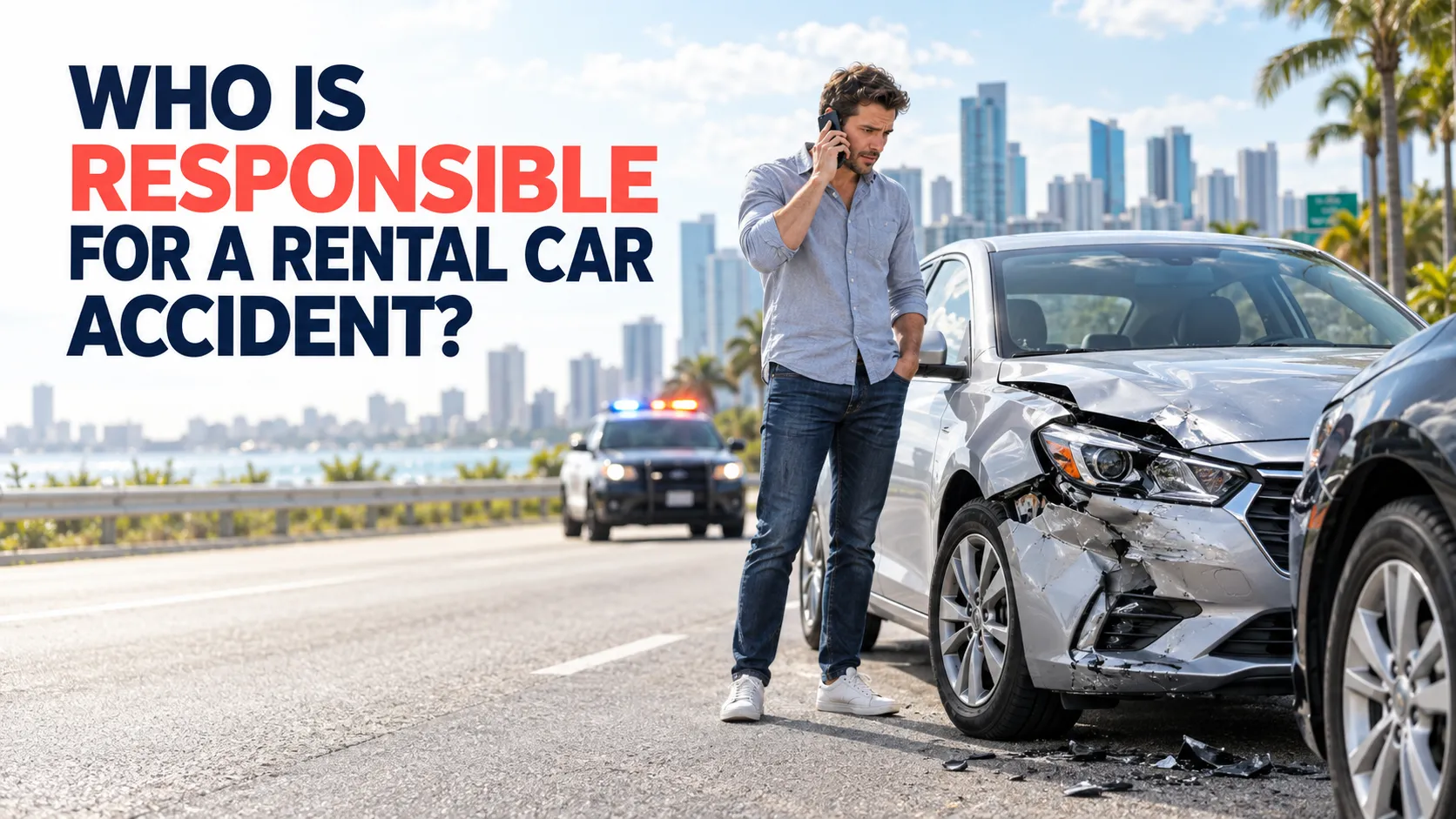
Suppose you are driving a rental car on vacation when another vehicle suddenly hits you at an intersection. A few seconds later, you are standing beside a damaged car that does not belong to you, wondering who must pay.
Who Is Responsible for a Rental Car in an Accident?
The short answer is that the at-fault driver may be legally responsible for causing the accident, but you remain responsible for following your rental agreement and reporting the damage. Who ultimately pays may depend on the other driver’s insurance, your personal auto policy, the rental company’s protection, your credit-card benefits, and local law.
That difference is where most of the confusion begins.
You Did Not Cause the Accident – So Why Is the Rental Company Calling You?
Return to the roadside for a moment.
The other driver apologizes and says the accident was their fault. A police officer takes information, and the other driver gives you an insurance card. It may seem obvious that their insurance company will handle everything.
Then you call the rental company.
The representative asks for photographs, the police-report number, the other driver’s details, and an accident form. You are told not to arrange repairs yourself and that the rental company may contact you about the damage.
That can feel unfair when you did not cause the crash.
However, two different relationships are involved:
- The accident claim determines who was legally responsible for causing the collision.
- The rental agreement controls your responsibilities while the vehicle is in your possession.
The rental company owns the car, but you accepted contractual responsibility for it during the rental. The company may therefore communicate with you, inspect the vehicle, process the damage claim, or place a temporary charge or hold where the agreement and applicable law permit.
That does not automatically mean you must personally absorb the final cost.
Who Is Responsible for a Rental Car Accident?
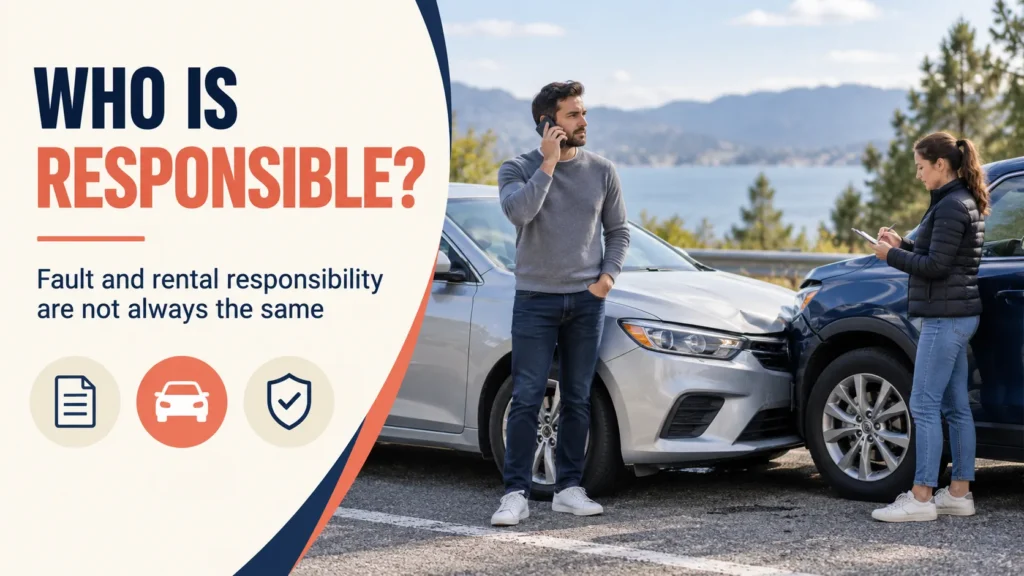
Responsibility usually depends on who caused the accident, who was authorized to drive, what protection was selected, and which policies apply.
When You Caused the Accident
If you caused the collision, you may be responsible for several different categories of loss:
- Damage to the rental car
- Damage to another vehicle or other property
- Injuries to other people
- Your own medical expenses
- Towing or recovery costs
- Possible administrative or loss-of-use charges
- Your insurance deductible
Different coverage handles different losses.
For example, a collision damage waiver may address damage to the rental vehicle but not another person’s injuries. Liability coverage may address third-party injury and property-damage claims but not necessarily the rental car itself.
This is why saying, “I have rental-car insurance,” does not fully answer the question.
When Another Driver Caused the Accident
If another driver caused the accident, that driver’s liability insurer may be responsible for covered damage and injuries, subject to local law, coverage limits, and the insurer’s investigation.
But the process may not be immediate.
The other insurer may need statements, photographs, the police report, repair estimates, and confirmation of responsibility. If fault is disputed or the other driver is uninsured, the claim can become more complicated.
While that investigation continues, the rental company may still deal directly with you because your name appears on the rental agreement.
Not being at fault does not remove your reporting obligations.
Give the rental company the other driver’s information, but do not assume that exchanging insurance cards completes the process.
When Both Drivers Share Responsibility
Some accidents do not have one entirely responsible driver. Depending on the location, liability may be divided between the drivers.
For example, one driver may have changed lanes without enough space while the other was speeding. How shared responsibility affects payment depends on the jurisdiction’s negligence rules and the evidence available.
Avoid deciding the percentages yourself at the roadside. Provide accurate facts, photographs, witness details, and official reports to the rental company and insurers.
When the Responsible Driver Cannot Be Identified
Hit-and-run crashes, parking-lot damage, vandalism, falling objects, storms, and animal collisions may not involve an identifiable at-fault driver.
In these situations, payment may depend on:
- The loss or collision damage waiver you accepted
- Your personal comprehensive or collision coverage
- Eligible credit-card rental protection
- Uninsured-motorist property-damage coverage, where available
- The rental agreement and local law
Report the event promptly even when the damage looks minor.
The Renter Can Be Contractually Responsible Without Being Legally at Fault
This is the most important distinction in the article.
Fault asks who caused the collision. Contractual responsibility asks what you agreed to do with the rental vehicle.
Avis, for example, states that the renter is held responsible for rental-car damage and instructs renters to contact the police, complete an incident report, call roadside assistance, notify their insurer, and check applicable credit-card benefits.
The exact wording and available protection vary by rental company and location. Always use the agreement issued for your booking rather than assuming one company’s policy applies to another supplier.
Your agreement may require you to:
- Report every collision or damage event promptly
- Contact the police when required
- Complete the rental company’s accident form
- Avoid admitting or negotiating liability
- Use the company’s approved towing procedure
- Protect the vehicle from further damage
- Provide insurance and witness information
- Cooperate with the claim investigation
Failing to follow these requirements may affect a waiver or insurance claim.
Who Actually Pays for the Damaged Rental Car?
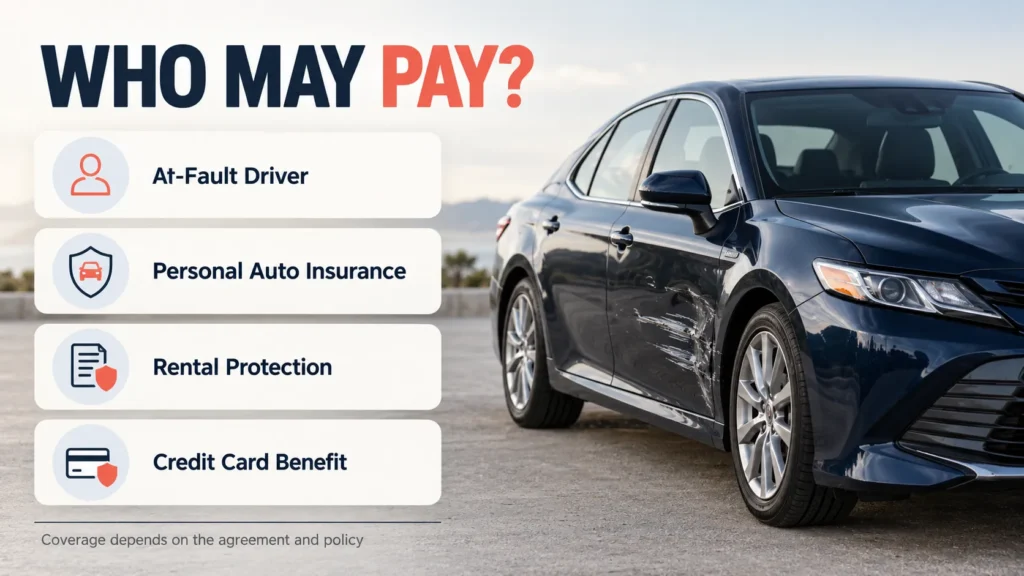
There is no universal payment order. The following sources may apply individually or together.
1. The Other Driver’s Liability Insurance
When another driver caused the crash, their property-damage liability coverage may pay for damage to the rental vehicle.
However, the insurer normally investigates before accepting the claim. Payment may also be limited by the driver’s coverage limit.
If the other insurer delays or disputes responsibility, your own coverage or the rental company’s damage waiver may respond first and later seek reimbursement. Ask the claim handler how recovery will work rather than paying an unfamiliar invoice without checking it.
2. A Loss Damage Waiver or Collision Damage Waiver
Rental companies commonly offer a loss damage waiver or collision damage waiver. Despite the familiar word “coverage,” this is often a contractual waiver rather than a traditional insurance policy.
When valid, it may reduce or eliminate your financial responsibility for covered damage to the rental vehicle.
It does not necessarily cover:
- Injuries to other people
- Damage to another vehicle
- Personal belongings
- Prohibited or unauthorized use
- An unauthorized driver
- Certain reckless, illegal, or off-road driving
- Every fee connected with the incident
Avis explains that its loss damage waiver can reduce what a renter pays for vehicle damage, provided the rental agreement is followed. Its options and terms vary by location.
Read the actual waiver terms before relying on the name alone.
3. Your Personal Auto Insurance
A U.S. personal auto policy may extend some coverage to a rental car, but this is not automatic in every circumstance.
The NAIC advises consumers to ask whether their policy covers an accident in a rental car while on vacation because coverage can vary by state and policy. It also explains that liability, collision, comprehensive, medical, and uninsured-motorist protections serve different purposes.
Ask your insurer:
- Does my collision coverage extend to this rental?
- Does my liability coverage apply?
- What deductible will I owe?
- Is loss of use covered?
- Are administrative or diminished-value claims covered?
- Does coverage apply outside the United States?
- Are business rentals or certain vehicles excluded?
Do this before your trip whenever possible.
4. Your Credit-Card Rental Benefit
Some credit cards offer rental-car collision protection when you pay for the rental with the eligible card and comply with the benefit’s conditions.
But many travelers misunderstand what this benefit covers.
Credit-card rental protection commonly focuses on theft or physical damage to the rental vehicle. It may exclude injuries, damage to another person’s car, personal belongings, and lawsuits arising from third-party injury or property damage.
For example, Chase’s published Sapphire Reserve benefit guide says its auto-rental coverage can reimburse covered theft or collision damage to the rental vehicle but does not cover injury to anyone or damage to another driver’s vehicle or other property. Eligibility also depends on conditions such as using the eligible card and complying with the rental terms.
Coverage may be either:
- Primary: It may respond before your personal auto insurance.
- Secondary: It normally pays after eligible personal insurance benefits.
Never assume that using a credit card automatically gives you coverage. Read the current Guide to Benefits and contact the benefit administrator before renting.
5. Additional Liability Protection
Liability protection is designed for claims made by other people for injuries or property damage.
This is separate from a waiver covering the rental vehicle.
The amount and priority of liability coverage can vary significantly by jurisdiction. Avis, for example, notes that the liability protection included with its vehicles varies by state and that the renter’s personal insurance may be primary in some locations.
If you do not own a car or carry personal auto insurance, ask the rental supplier exactly what liability coverage comes with the booking and what optional protection is available.
What If an Additional Driver Was Driving?
If an additional driver was properly listed and authorized under the agreement, applicable coverage may still respond, subject to the policy and rental terms.
The situation can be different when an unlisted person was driving.
An unauthorized driver may create a breach of the rental agreement and could place damage-waiver or insurance benefits at risk. Even if that person had permission from you, permission alone may not make them an authorized rental driver.
Before leaving the pickup location, make sure every person who may drive is properly included.
What to Do Immediately After a Rental Car Accident
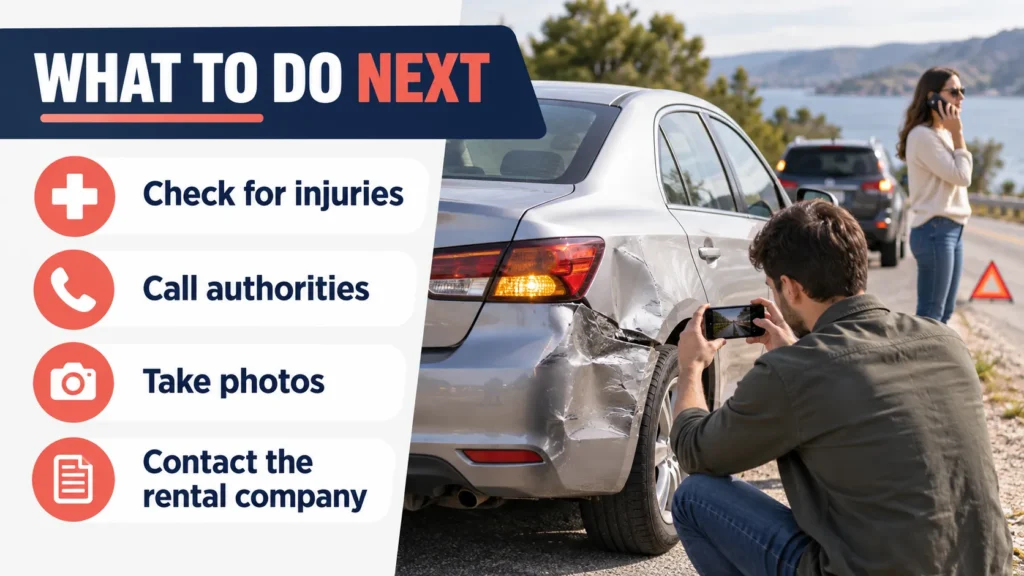
The minutes after a collision can affect both safety and the later claim.
1. Stop and Check for Injuries
Move to a safer place if it is legal and safe to do so. Call emergency services when anyone is injured, the road is blocked, there is a fire risk, or the situation is dangerous.
Do not leave the scene before completing duties required by local law.
2. Contact the Police When Required
Police-reporting requirements vary by country, state, injury status, and amount of damage.
Even when officers do not attend minor crashes, you may still need to file a report separately. Follow the rules of the place where the collision occurred – not the rules from your home state.
3. Exchange Essential Information
Collect the other driver’s:
- Full name
- Phone number
- Address, where required
- Driver’s-license information
- License-plate number
- Insurance company and policy information
- Vehicle make, model, and color
Also obtain contact details from witnesses.
4. Photograph the Entire Scene
Take photographs or video of:
- Every damaged vehicle
- All sides of the rental car
- License plates
- Road signs and traffic signals
- Lane markings
- Skid marks or debris
- Weather and road conditions
- The wider accident location
Do not photograph only the most obvious dent. Wider images can help explain how the collision happened.
5. Contact the Rental Company
Use the accident or roadside-assistance number in your agreement.
Ask whether the car is safe to drive, where it should be taken, which towing company to use, and whether a replacement vehicle is available.
Do not arrange repairs yourself unless the rental company authorizes them.
6. Notify the Relevant Insurers and Card Provider
Depending on your situation, notify:
- Your personal auto insurer
- The rental company’s protection administrator
- Your credit-card benefit administrator
- The other driver’s insurer
- Your travel insurer, if applicable
Ask for a claim number and write down every deadline.
7. Keep Every Document
Save the rental agreement, checkout inspection, accident form, police information, photographs, emails, receipts, towing papers, repair documents, and claim correspondence.
A claim can continue long after your vacation ends.
Should You Admit Fault at the Scene?
You should provide honest facts and cooperate with police, the rental company, and insurers. However, avoid guessing, arguing about percentages, promising payment, or signing an unfamiliar private settlement at the roadside.
A simple statement such as “I am shaken and want to exchange the required information” is safer than trying to resolve the entire claim in the parking lot.
The evidence and applicable law – not the loudest driver – determine responsibility.
Can the Rental Company Charge Your Credit Card?
A rental company may place a deposit, authorization hold, or damage-related charge where allowed by the rental agreement and applicable law.
That charge does not necessarily represent the final insurance decision.
If you receive a damage claim, request an itemized explanation and supporting documents. Send the claim promptly to any insurer or card-benefit administrator that may apply. Follow formal dispute procedures if you believe a charge is unsupported; do not simply ignore it.
How to Reduce the Risk Before Your Next Rental
The best time to investigate accident responsibility is before anyone hands you the keys.
Before booking:
- Compare the total rental conditions, not only the daily price.
- Identify the actual rental supplier.
- Read the collision and liability sections.
- Confirm the deductible or excess.
- Check whether additional drivers must be registered.
- Ask your insurer about domestic and international rentals.
- Read your credit card’s current benefits guide.
- Photograph existing vehicle damage at pickup.
- Save the roadside-assistance number offline.
One careful check before the trip can prevent several stressful phone calls afterward.
Comparing Rental Cars Before Your Trip

A comparison platform can help you review available vehicle categories and suppliers before booking. However, it does not replace the rental company’s agreement or your insurance documents.
Trip.com
When you compare rental cars on Trip.com, look beyond the vehicle photograph and initial rate. Open the offer’s rental conditions and identify the company that will supply the car.
Compare the deposit, deductible, mileage allowance, driver rules, cancellation terms, and included protection. Trip.com itself advises customers to read the supplier’s terms because requirements and practices can vary between rental companies.
Klook
Klook’s car-rental search can help you compare available cars for your destination. Before selecting an offer, check the named supplier, pickup instructions, driver requirements, coverage information, and cancellation conditions.
If any accident-related term is unclear, contact the supplier before the free-cancellation deadline. A low rate may not be the better deal when it comes with a large deductible or exclusions that do not fit your trip.
Booking.com
You can also review rental-car options through Booking.com, then compare the actual supplier and conditions attached to each offer.
Pay particular attention to the protection summary, deposit, authorized-driver rules, geographic restrictions, fuel policy, and instructions for contacting the supplier. Save the final confirmation and rental terms offline so you can access them if an accident occurs without a reliable internet connection.
These platforms help you compare options.
The supplier’s rental agreement decides the conditions of the car you ultimately collect.
Frequently Asked Questions
Am I responsible if someone hits my rental car?
You may not be legally at fault, but you must still report the collision and comply with your rental agreement. The other driver’s insurer may ultimately pay covered damage, although your rental protection or insurance may become involved while responsibility is investigated.
Does a collision damage waiver cover the other car?
Usually, a collision or loss damage waiver primarily concerns damage to the rental vehicle. Liability protection is the coverage designed for injury or property-damage claims made by other people. Check the specific terms.
Will my credit card cover the entire accident?
Not necessarily. Many card benefits focus on theft or collision damage to the rental vehicle and exclude injuries, third-party property damage, and liability claims. Eligibility conditions and exclusions vary by card.
What happens if I crash a rental car without insurance?
You may face personal responsibility for losses not covered by required local protection or another applicable policy. The exact outcome depends on local law and the rental agreement. Notify the rental company immediately and investigate every potentially applicable policy.
Can I get another rental car after the accident?
Possibly, but it is not automatic. The rental company will decide whether it can provide a replacement based on availability, the accident circumstances, your agreement, and payment or authorization requirements.
Who pays the rental car’s deductible?
The renter may initially owe a deductible under personal or rental coverage. An at-fault driver’s insurer or eligible secondary benefit may later reimburse it, depending on the claim and policy terms.
The Bottom Line
Who is responsible for a rental car in an accident depends on more than one question.
The driver who caused the crash may be legally liable. You, as the renter, remain responsible for reporting the incident and protecting the rental vehicle under your agreement. The final payment may come from the at-fault driver’s insurance, your own auto policy, a rental-company waiver, liability protection, or an eligible credit-card benefit.
Your safest response is simple: protect people first, document the accident, contact the authorities when required, notify the rental company promptly, and open the correct insurance claims.
Do not wait until the car is due back to explain what happened.
This article provides general information, not personalized legal or insurance advice. Rules and coverage vary by location, rental agreement, insurer, card benefit, driver authorization, and accident circumstances.
This article contains affiliate links. If you purchase through our links, we may earn a commission at no extra cost to you. We only recommend products we genuinely believe in. Read our Affiliate Disclaimer for full details.