No official Samsung Exynos 2700 AnTuTu score has leaked yet. What has surfaced is Geekbench 6 data showing 2,603 single-core and 10,350 multi-core points on an early engineering sample, plus a 15,618 OpenCL result for its Xclipse 970 GPU. Final AnTuTu numbers will likely follow closer to the Galaxy S27 launch.
Table of Contents
That’s the short answer, and it matters because a lot of headlines right now imply a finished AnTuTu figure exists. It doesn’t, not officially. What we do have is real, sourced data from Geekbench listings, and it tells a genuinely interesting story about where Samsung’s next flagship chip is headed.
Let’s break down exactly what’s confirmed, what’s rumor, and what it means if you’re planning to buy a Galaxy S27. We’ll cover the verified Exynos 2700 benchmark data, the Exynos 2700 Geekbench score history, and how the chip stacks up against Qualcomm’s upcoming flagship.
Why There’s No Verified Samsung Exynos 2700 AnTuTu Score Yet
Here’s the thing about early chip leaks: AnTuTu listings almost never show up before Geekbench ones. AnTuTu requires a more complete software stack, stable drivers, and a functioning UI layer to run its combined CPU, GPU, memory, and UX tests. Engineering samples running months ahead of launch rarely have that ready.
So when you search for a Samsung Exynos 2700 AnTuTu score today, you’ll mostly find speculation or numbers extrapolated from Geekbench. That’s not a knock on the reporting, it’s just how the leak cycle works. Chips typically get their first public AnTuTu run only weeks before or after a phone’s retail debut, based on benchmark coverage of prior Exynos chips like the Exynos 2500, which posted an AnTuTu score of 1,777,598 on the Galaxy Z Flip 7.
For readers tracking every angle of the Galaxy S27 Ultra design leak, this benchmark story is the performance half of that same puzzle.
Exynos 2700 Benchmark: The Verified Geekbench and OpenCL Numbers
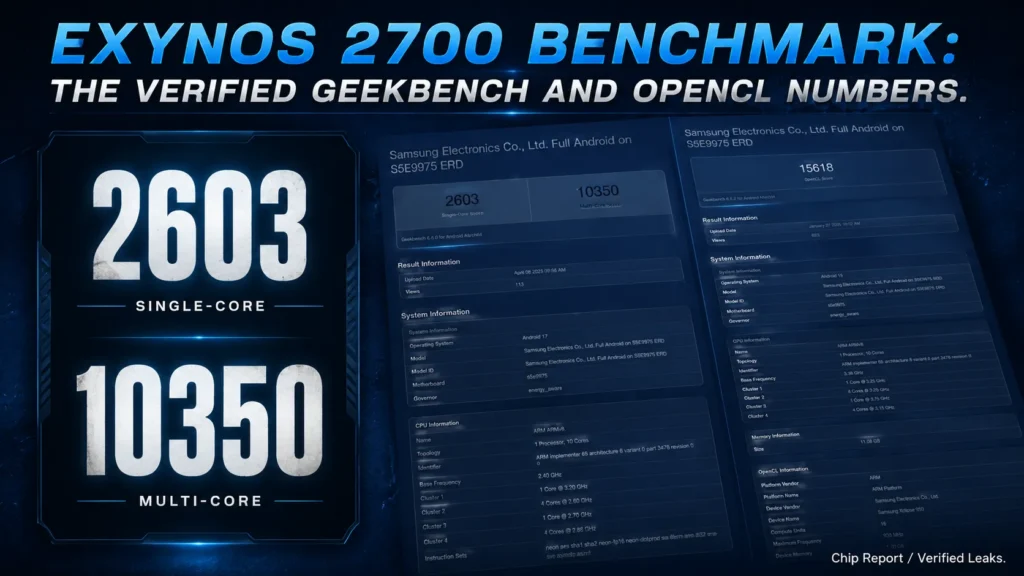
Here’s the real Exynos 2700 benchmark data, pulled from an actual Geekbench 6 database listing reported by GSMArena in April 2026.
| Test | Score | Source |
| Geekbench 6 Single-Core | 2,603 points | GSMArena Geekbench listing |
| Geekbench 6 Multi-Core | 10,350 points | GSMArena Geekbench listing |
| Xclipse 970 GPU (OpenCL) | 15,618 points | GSMArena Geekbench listing |
The tested unit carried the model number S5E9975 with an “ERD” tag, meaning it ran on an engineering reference design rather than a finished phone. It packed 12GB of RAM and a 10-core CPU split into a 1+4+1+4 cluster layout, with a prime core at 2.78GHz, four performance cores at 2.88GHz, one low-power core at 2.30GHz, and four efficiency cores at 2.40GHz.
A later listing spotted in August 2026 showed something more promising. That sample ran an unlocked configuration with the prime core hitting 4.24GHz, alongside an unannounced Arm CPU core internally referred to as “Canyon”, tested on Android 17 with roughly 11GB of RAM. If you want the fuller picture on that OS, our breakdown of Android 17 QPR2 features covers what’s shipping alongside these new chips.
Industry analysts at TrendForce noted the efficiency angle is what stands out most. Qualcomm’s latest Snapdragon 8-series chips reach around 11,000 points at peak clock speeds near 4.3 to 4.6GHz, while the Exynos 2700 topped 10,000 points at just 2.88GHz, which points to solid performance-per-watt for an early sample still being tuned.
Exynos 2700 Geekbench Score vs the Exynos 2600: The Generational Jump
For context, the current Exynos 2600 already posted a single-core score of 3,309 points and a multi-core score of 11,256 points on Geekbench in its finished form. That’s actually higher than the Exynos 2700’s early engineering numbers, which makes sense once you remember the newer chip is still running on unoptimized firmware.
A PhoneArena report on the chip’s architecture suggested Samsung could push the finished Exynos 2700 Geekbench score to roughly 4,800 points in single-core and 15,000 points in multi-core, a jump of about 40% and 30% over the Exynos 2600 respectively, once the silicon reaches full clock speeds. Take that projection as an estimate from a source without an established track record, not a confirmed figure.
Rising component costs are also part of this story. If you’ve followed the recent RAM price surge affecting phone makers, that same memory crunch could shape how much RAM Samsung includes alongside the Exynos 2700 in retail units.
Exynos 2700 vs Snapdragon: How Do the Numbers Compare?
This is where the Exynos 2700 vs Snapdragon debate gets genuinely interesting. A South Korean outlet, SEDaily, reported on an internal Samsung evaluation comparing the two chips directly, a story later picked up by Android Authority.
According to that report, the Exynos 2700 scored 19% higher than the Snapdragon 8 Elite Gen 6 in Geekbench 6.5 multicore tests, and it also beat the Snapdragon 8 Elite Gen 6 Pro by 9.5% in the same benchmark. The chip reportedly went further still, delivering 5% better peak performance and 24% better results in low-power testing compared to the Snapdragon 8 Elite Gen 6 Pro.
| Metric | Exynos 2700 (Rumored) | Snapdragon 8 Elite Gen 6 Pro |
| Multicore vs Gen 6 Pro | +9.5% | Baseline |
| Peak Performance | +5% | Baseline |
| Low-Power Efficiency | +24% | Baseline |
| Process Node | 2nm SF2P (Samsung Foundry) | TSMC N3 (expected) |
Treat this Exynos 2700 vs Snapdragon comparison as directional, not final. It comes from an in-house Samsung test, not an independent lab, and both chips are still in development.
Samsung Exynos 2700 Release Date: When Will It Actually Launch?
The Samsung Exynos 2700 release date lines up with the Galaxy S27 series. Multiple industry trackers point to a January or February 2027 Galaxy Unpacked event, with retail availability expected around mid-February.
Here’s what to watch leading up to that Samsung Exynos 2700 release date:
- September-October 2026 – First FCC and regulatory filings typically appear.
- November 2026 – Display panel orders and mass production usually begin.
- December 2026 – CAD-based renders start circulating from established leakers.
- January-February 2027 – Galaxy Unpacked event and official Exynos 2700 reveal.
Samsung is also reportedly targeting mass production of its second-generation 2nm process, SF2P, in the second half of 2026, which lines up with an early 2027 phone launch. The chip will reportedly pair with LPDDR6 RAM and UFS 5.0 storage in final devices, according to earlier PhoneArena reporting on the platform.
Samsung Exynos 2700 AnTuTu Score FAQs
Q1. Has an official Samsung Exynos 2700 AnTuTu score been released?
No. As of this writing, only Geekbench 6 and OpenCL results have leaked. No verified AnTuTu listing has surfaced for the Exynos 2700.
Q2. What is the current Exynos 2700 Geekbench score?
Early engineering samples scored 2,603 in single-core and 10,350 in multi-core tests, according to Geekbench database listings.
Q3. Will the Exynos 2700 beat the Snapdragon 8 Elite Gen 6 Pro?
A Samsung internal test reportedly showed the Exynos 2700 outperforming it by 9.5% in multicore and 5% in peak performance, per SEDaily’s report.
Q4. What GPU does the Exynos 2700 use?
The Xclipse 970, reportedly developed fully in-house by Samsung without AMD’s involvement.
Q5. When is the Samsung Exynos 2700 release date?
It’s expected to debut with the Galaxy S27 series at a Galaxy Unpacked event in January or February 2027.
Q6. What process node powers the Exynos 2700?
Samsung Foundry’s second-generation 2nm process, known as SF2P.
Q7. How many CPU cores does the Exynos 2700 have?
Ten cores, arranged in a 1+4+1+4 quad-cluster layout, a departure from the standard tri-cluster design used in earlier Exynos chips.
Q8. Which phones will use the Exynos 2700?
It’s rumored for the base Galaxy S27 and Galaxy S27 Plus in most regions, while the Ultra and Pro models may use Snapdragon chips.
Q9. Is the current Exynos 2700 benchmark data reliable?
It comes from an engineering sample with an “ERD” designation, so scores are expected to improve significantly before the final retail chip ships.
Q10. How does the Exynos 2700 compare to the Exynos 2600 so far?
The finished Exynos 2600 currently scores higher on Geekbench than the early Exynos 2700 sample, but that’s expected to flip once the newer chip is fully optimized.
The Bottom Line
There’s no confirmed Samsung Exynos 2700 AnTuTu score to report yet, and anyone claiming otherwise is likely working from unverified extrapolations. What’s solid is the Geekbench and OpenCL data, plus a Samsung-sourced comparison suggesting real gains over Qualcomm’s next flagship chip.
If the SEDaily figures hold up, the Exynos 2700 vs Snapdragon story could look very different from past generations, where Exynos chips regularly trailed their Qualcomm counterparts. We’ll update this article the moment a verified Samsung Exynos 2700 AnTuTu score appears.