
Yes, some rental cars have GPS trackers or built-in connected-car systems that can collect location and vehicle-use data. However, not every rental car has the same equipment, and tracking capability does not mean an employee watches every journey. Check the rental supplier’s privacy notice and ask about your specific vehicle before driving away.
Table of Contents
Avis and Enterprise both disclose connected-vehicle technology in their published policies. The useful questions are what your car collects, when the supplier accesses it, and what choices you have. This guide explains those distinctions for U.S. travelers, including people renting overseas.
Policies checked September 9, 2026. Affiliate disclosure: We may earn a commission if you book through the affiliate links in this article.
Do rental cars have trackers in every vehicle
A rental company’s privacy policy describes what it may collect across relevant services and vehicles. It does not provide a vehicle-by-vehicle equipment list. Avoid assuming that every car at a branch has an active tracker, or that a small local agency uses no tracking technology.
For a specific reservation, ask the pickup branch whether the assigned car has active location reporting. If privacy affects your decision to rent, ask before the cancellation deadline rather than after you reach the counter.
Your booking confirmation, rental agreement, connected-car disclosures, and the vehicle manufacturer’s privacy notice may each cover a different part of the arrangement. Keep copies of the documents that apply to your rental.
What information can a rental car collect

A tracker can be part of a broader telematics system: technology that collects and communicates vehicle information. Rental suppliers may receive data through manufacturer-built systems or installed equipment. You do not need to see a separate device for a vehicle to have connected features.
The table summarizes examples disclosed across the Avis and Enterprise policies. It describes possible capabilities, not equipment confirmed in every rental.
| Information | What it may tell the supplier | Practical question |
| Vehicle location | Where the car is | When is precise location accessed? |
| Odometer and fuel data | Mileage and fuel status | Does this support return billing? |
| Diagnostics | Maintenance or performance issues | What vehicle condition data is collected? |
| Speed and braking | Aspects of vehicle operation | Are driving events recorded or used? |
Enterprise identifies purposes including roadside help, vehicle recovery, return processing, fuel and mileage billing, and maintenance. Its policy also distinguishes event-recorder information used in certain accident claims. That is a reason to ask about individual systems rather than treating every kind of vehicle data as live GPS tracking.
Does turning off my phone stop vehicle tracking
Do not assume so. Your phone’s location permission and the car’s own connected systems are separate controls. Enterprise notes that some vehicle features may stay active when other in-car services or media are off. Removing an app or disconnecting Bluetooth does not establish that the vehicle has stopped reporting data.
Why rental companies use location data
Avis’s rental terms describe location uses that include recovering overdue or missing vehicles, providing assistance, and managing its fleet. The terms also discuss connected-car information for rental administration and claims. Tracking therefore has purposes beyond theft recovery.
However, technical capability and actual access are different. A policy permitting location use does not reveal how often an employee opens a particular vehicle’s record. Ask the supplier what happens during an ordinary rental and which events trigger additional access.
If you need more time with the car, arrange an extension through the approved process and retain confirmation. Avoid relying on an unanswered message as proof that the return deadline changed.
Can they tell if I cross a border or drive too fast
Location data may reveal travel outside an approved area, and some connected systems can collect speed. Neither capability establishes that every supplier issues automatic penalties. Any restriction or charge needs to be assessed against the applicable agreement and local rules.
Before a long drive, confirm authorized countries, mileage limits, and one-way return arrangements. Use our Route 66 road trip itinerary to plan the journey, then check that your rental terms support the route you choose.
How to protect your privacy before returning a rental car
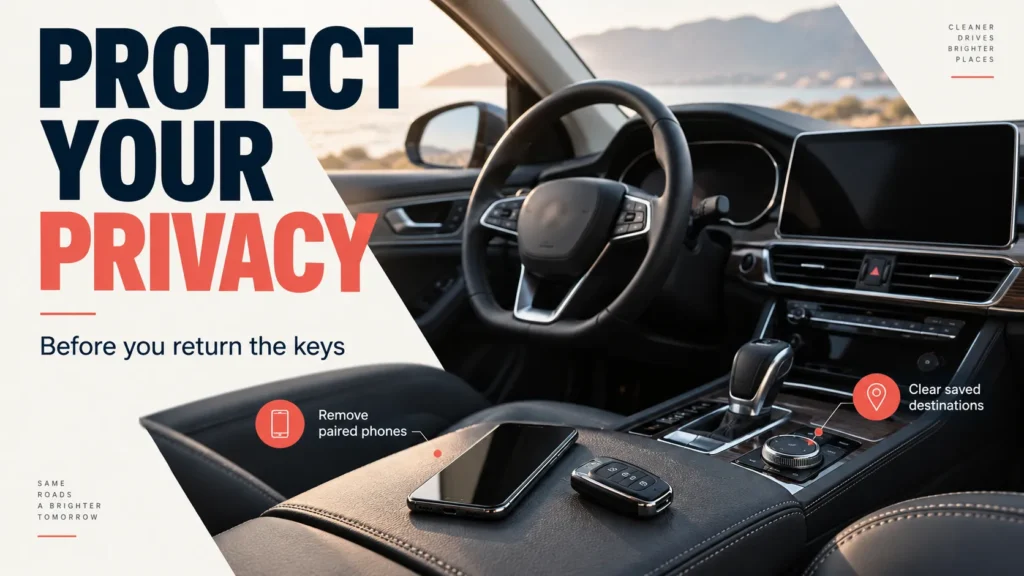
The FTC warns that rental-car infotainment systems may retain information from connected phones, including contacts and destinations. Its advice includes limiting permissions and deleting your information before return.
Use this practical checklist while the car is parked:
- Decline unnecessary contact or message syncing when pairing your phone.
- Remove your phone from the car’s paired-device list before return.
- Clear destinations or other personal details you saved in the navigation system.
- Sign out of personal accounts you used through the vehicle.
- Ask staff for help if you cannot locate the relevant deletion controls.
Allow a few minutes for this before handing over the keys. Doing it at the return bay is easier than discovering afterward that your address book is still paired to the car.
These steps address information accessible through the car’s interface. They do not establish that the rental company or manufacturer deleted information already transmitted to their systems. Use the applicable privacy contact for questions about retained records; do not assume an in-car reset is a company-wide deletion request.
How to find out whether your rental car is tracked
Ask the branch a specific question: “Does this vehicle collect or transmit precise location data during my rental, and where can I read the applicable policy?” Follow up about the equipment, data recipients, retention, and available choices.
Avis directs uncertain renters to its location staff and says it cannot guarantee a car without connected features. A request for a different vehicle is therefore worth making, but it is not a guaranteed option.
Do not unplug equipment or dismantle the vehicle to investigate. Ask staff to identify unfamiliar devices and explain any permitted controls. If the answer is unclear, request written clarification or another car before accepting it.
For an international booking, confirm the local supplier’s requirements separately. Our guide to credit cards for rental cars in Morocco covers another issue that is best resolved before pickup.
Comparing car rentals on Trip.com Klook and Booking.com

A booking platform can help you compare offers, but the named rental supplier remains essential to your tracking questions. Check the supplier, pickup location, cancellation terms, deposit, mileage allowance, and connected-car disclosures for the offer you select.
Trip.com
Trip.com offers car-rental searches by pickup location and dates. It is an option for travelers who want to compare car offers while arranging other travel. Before paying, review the rental conditions and identify which supplier will hand over the keys; do not treat a platform booking as confirmation of a particular tracking policy.
Klook
Klook also provides a car-rental search. Check the offers available for your destination, the named operator, and the pickup instructions. Our Klook review provides broader platform context, while the individual rental conditions should guide this booking.
Booking.com
Booking.com’s car-rental service lets travelers search rental offers for their trip. Compare the full conditions with the other platforms, including cancellation and pickup requirements. Ask vehicle-data questions of the named supplier before committing if privacy is a deciding factor.
No platform is a universal winner here. Compare equivalent pickup times, car categories, included mileage, and protection terms. A cheaper headline price does not settle whether an offer suits your trip. The FTC recommends comparing total rental costs, including fees and optional extras.
Frequently asked questions
Do rental cars have cameras or microphones
Some connected vehicles may have image or audio capabilities, according to Avis. This does not establish that every rental records its occupants. Ask about the specific model, active features, and applicable disclosure.
Can I request a rental car without tracking
You can ask, ideally before paying a nonrefundable amount. Get confirmation about the actual vehicle and available alternatives. Do not assume a supplier can guarantee a car without connected features.
Can a rental company remotely disable a car
Avis’s terms include remote engine-disable or ignition-cancel functionality among possible connected services. They do not establish that every car supports it or that a moving car will shut down. Contact the supplier if the vehicle will not start.
How long do rental companies keep tracking data
There is no single retention period established by the policies reviewed for every rental and data category. Ask the responsible company which schedule applies to your vehicle information and where to submit a privacy request.
What to check before accepting the keys
Do rental cars have trackers? Some do, including through built-in connected systems. Choose a rental with clear terms, ask about the specific vehicle, and resolve privacy concerns before accepting it. Keep your agreement, follow the approved route and return conditions, and remove personal infotainment data before handing the car back.
This article contains affiliate links. If you purchase through our links, we may earn a commission at no extra cost to you. We only recommend products we genuinely believe in. Read our Affiliate Disclaimer for full details.