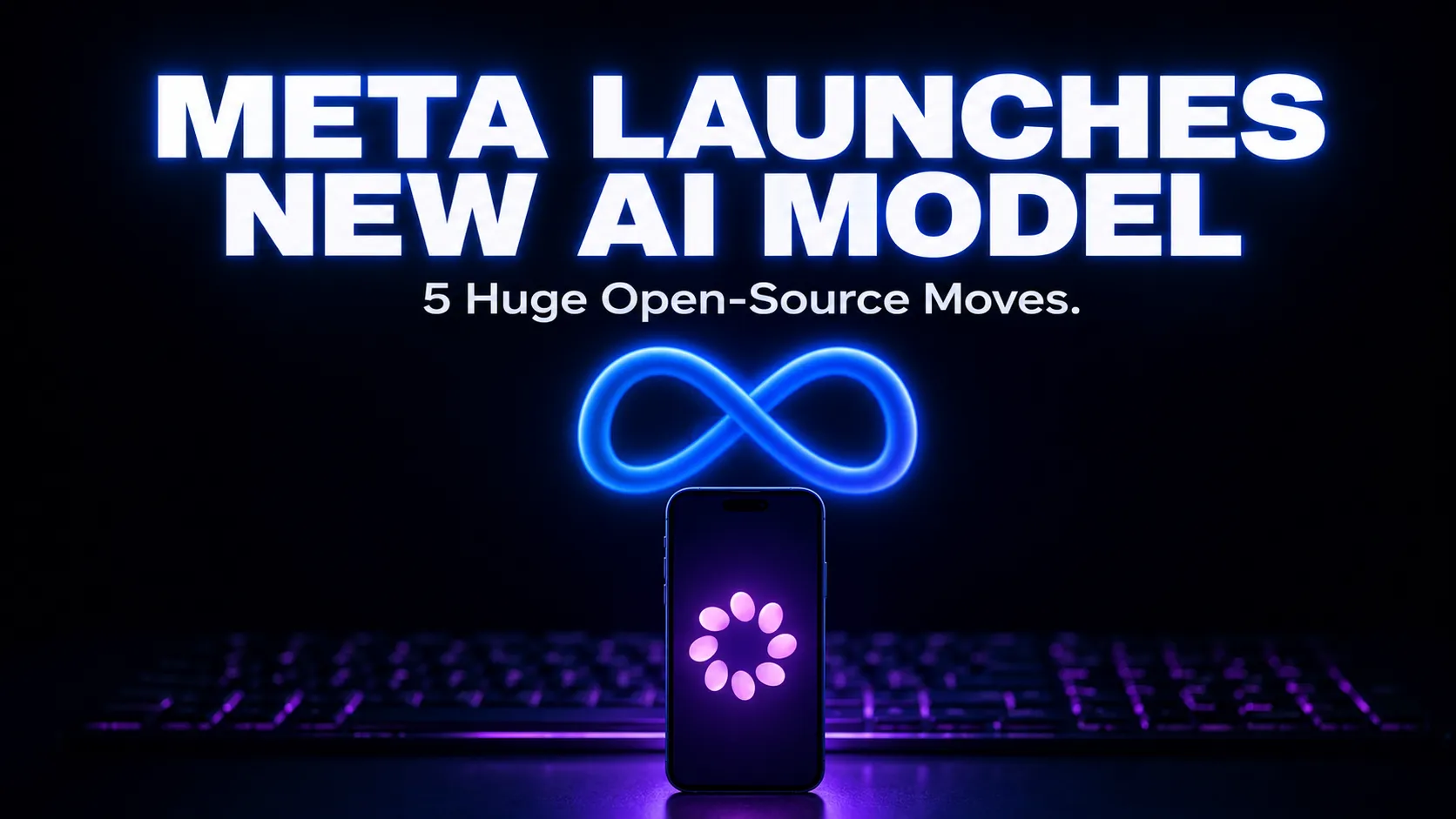
Meta launches new AI model this week, and the tech world is talking again. On August 10, 2026, the company introduced Muse Glimmer, a 30-billion-parameter system built for everyday tasks on your own laptop. CEO Mark Zuckerberg used the launch to push for looser U.S. rules on open-weight AI, arguing that American labs need room to compete with China.
Table of Contents
No cloud subscription is required this time. Muse Glimmer runs locally, and that alone makes it one of the more practical AI stories of the year. Here is everything worth knowing, without the filler.
What Is Muse Glimmer, Exactly?
Muse Glimmer comes from Meta Superintelligence Labs, the division Zuckerberg built to chase advanced AI. The model carries 30 billion parameters, which sounds huge until you compare it with today’s giant cloud models. That smaller size is the whole point. Muse Glimmer fits on a single consumer GPU, so a Mac or a mid-range gaming PC can run it without breaking a sweat, or your electricity bill.
Meta released the weights on Hugging Face under the Apache 2.0 license, according to Meta AI Research. That means developers can download, inspect, and modify the model freely. It is built for agentic work such as booking tasks, coding help, tool calls, and multi-step reasoning that keeps going even when one step fails.
Meta Unveils ‘Open Source’ Version – Why Now?
Meta unveils ‘open source’ version of its agentic model at an interesting moment. Chinese labs such as Moonshot’s Kimi K3, Alibaba’s Qwen3.8-Max, and DeepSeek’s V4-Flash have been closing the gap with U.S. systems, according to Reuters. Zuckerberg argues American companies face extra training-data restrictions that foreign labs do not, and he wants Washington to ease that friction.
It is a fair point, even if you roll your eyes at a trillion-dollar company asking regulators for fewer rules. For a closer look at how Chinese open-weight models stack up against U.S. rivals, ExpertReviewsPro’s coverage of the global AI race breaks down the numbers in plain English.
Meta Releases Muse Glimmer With Real Agent Skills
Meta releases Muse Glimmer with a feature set aimed squarely at builders, not casual chatbot users. The model handles interleaved text and images, so it can read screenshots, charts, and documents in a single pass. It supports more than 100 languages and lets developers pick different reasoning strengths depending on the task at hand.
Optimized support for llama.cpp, MLX, and ExecuTorch is arriving soon, according to Meta’s technical blog, with access also planned through Ollama, LM Studio, and other developer tools. Meta clearly built Muse Glimmer to slot into workflows people already use, rather than forcing a new ecosystem on anyone.
Meta Launches New AI in Push for Best Open Source Model
Meta launches new AI in push for best open source model status, positioning Muse Glimmer directly against Google’s Gemma4-31B and Alibaba’s Qwen3.6-27B. The company says its own benchmarks show strong results for the model’s size on agentic tasks. Independent testing will settle how it performs outside Meta’s own numbers, and that is worth watching over the next few weeks.
This open approach sits right next to Meta’s other model, Muse Spark, which launched as closed and proprietary back in April 2026, according to Fortune. Zuckerberg has hinted that weights for Muse Spark 1.2 are coming too, so Meta’s open and closed strategies may eventually merge.
How Muse Glimmer Fits Meta’s Bigger AI Playbook
Meta Superintelligence Labs has gone through several shake-ups since forming in 2025, including a split into four separate units covering research, products, infrastructure, and superintelligence. Chief AI Officer Alexandr Wang leads the effort, backed by a capital spending plan that Meta expects to top 115 billion dollars in 2026. Readers curious about the hardware side of this story can check ExpertReviewsPro’s guide to AI-ready laptops, since Muse Glimmer’s appeal depends entirely on devices built to run it.
Market and Industry Reaction
Meta shares traded near 592 dollars around the announcement, a modest move rather than a dramatic swing, based on same-day market data. Investors appear to be waiting for independent benchmarks before reacting strongly either way. The launch also arrives during a rough week for AI security headlines, with reports of rogue agent incidents across several major labs, which may explain the cautious mood on trading desks.
The Bottom Line
Meta launches new AI model releases like Muse Glimmer signal a broader shift toward AI running on your own device, with less dependence on the cloud. Whether that approach beats the pure scale strategy favored by OpenAI and Anthropic remains an open question. For now, developers get a free, capable, open-weight model to experiment with, and that counts as a solid Monday for the AI world.
Frequently Asked Questions
What is Meta’s newest AI model?
Meta’s newest AI model is Muse Glimmer, a 30-billion-parameter open-weight model released on August 10, 2026, built for local agentic tasks like coding, tool use, and multi-step reasoning.
Which new AI is launched recently?
Meta recently launched Muse Glimmer, an open-weight agentic model that runs on a single consumer GPU, alongside its earlier proprietary model, Muse Spark.
What are the new launches of Meta?
Meta’s recent launches include Muse Spark, released in April 2026 for its apps, and Muse Glimmer, an open-weight model released in August 2026 for local agents.
What is the new AI launched in 2026?
In 2026, Meta launched two major models: Muse Spark for its consumer apps in April, and Muse Glimmer, an open-weight local agent model, in August.
What is Meta’s new AI model called?
Meta’s new open-weight AI model is called Muse Glimmer, a 30-billion-parameter system designed for local, always-on agent workflows.
Is Muse Glimmer open-source?
Muse Glimmer is open-weight under the Apache 2.0 license. Meta shares the model weights publicly, though full training data and code are not released.
Can Muse Glimmer run locally on a laptop?
Yes. Muse Glimmer is small enough to run on a Mac or PC with a single consumer graphics card, without needing cloud servers or a subscription.
How is Muse Glimmer different from Muse Spark?
Muse Glimmer is open-weight and built for local agent tasks. Muse Spark is Meta’s proprietary model that powers apps like WhatsApp, Instagram, and Facebook.
Why is Meta releasing open-weight AI models now?
Zuckerberg wants U.S. developers to compete with Chinese open-weight labs like Kimi K3 and Qwen, and believes eased data rules will help American models lead.
How does Muse Glimmer compare to Chinese AI models like Kimi K3 and Qwen?
Meta positions Muse Glimmer against similarly sized models like Qwen3.6-27B, reporting competitive benchmark results, though Chinese labs like Kimi K3 remain strong open-weight rivals.
What is Meta Superintelligence Labs?
Meta Superintelligence Labs, or MSL, is the division Meta formed in 2025 to build advanced AI, led by Chief AI Officer Alexandr Wang.
Will Meta release an open-weight version of Muse Spark?
Zuckerberg has said Meta plans to open the weights of Muse Spark 1.2, though the company has not confirmed a firm release date yet.
What does “open-weight” mean versus “open-source” AI?
Open-weight means the model’s parameters are public, but training data and code may stay private. Full open-source AI releases everything, including data and code.
How did Meta’s stock react to the Muse Glimmer launch?
Meta shares showed only a modest move around the announcement, trading near 592 dollars, as investors awaited independent benchmark results before reacting further.